












Posted on Mar 12, 2010 under General | Comments are off
Earlier this year the Summit on the Summit team comprised of celebrities Jessica Biel, Emile Hirsch, Kenna, Lupe Fiasco, Santigold and others climbed Mount Kiliamanjaro raise awareness about the global clean-water crisis. MTV is airing a 90-minute documentary about the celebrities’ climb on March 14.
The trailer is overly dramatic and exaggerates the conditions on the mountain, but should prove to be an entertaining film. The cinematagraphy is appears amazing.
Posted on Jan 13, 2010 under General | Comments are off
On January 12, Jessica Biel along with fellow celebrities on the Summit on the Summit team, climbed to the peak of Mount Kilimanjaro, Uhuru Point. Each member reached the top successfully.
Temperatures were reportedly in the single digits during the final ascent, which is not uncommon on the upper slopes of the mountain during nightime. The team also had to endure low visibility as snowy conditions.
Posted on Jan 10, 2010 under General | Comments are off
Jessica Biel and the rest of the Summit on the Summit team began their climb up Mount Kilimanjaro on Thursday, January 7th. The team is climbing Kilimanjaro to raise awareness for the global clean water crisis.
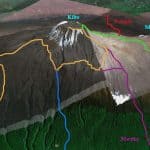
The website is sparse on details, but it appears that the group is ascending via a variation of the 7 day Shira route. They were at Moir Hut on day 3 and are currently at Barranco Camp on day 4.
A new report published in the journal Proceedings of the National Academy of Sciences has estimated that Mount Kilimanjaro’s glaciers will be gone within the next 20 year. Based on aerial photographs and extracts of ice, the authors measured the pace of the glacial retreat to arrive at their time frame.
Scientists have calculated that Kilimanjaro’s ice sheet has shrunk 85% since 1912, with the rate accelerating in recent. In the last 9 years, the three remaining ice fields have shrunk by 26%.
Posted on Oct 31, 2009 under Gear | Comments are off
We often get asked for recommendations on gear items. There are a myriad of quality brands and products, so what you ultimately find visually appealing, functional and economical is a personal choice. However, we would like to point out specific products that we find outstanding.
When it comes to climbing Kilimanjaro, one of the first questions people usually ask is,”how cold does it get?”
The highest camps that most sleep at are about 15,000 to 16,000 feet high, in the alpine desert zone. Nightime temperatures here hover around freezing, but can easily be much colder than that, as Kilimanjaro’s weather is volatile and unpredictable. So when choosing a sleeping bag, you want a warm, four season bag.
We recommend getting a bag with a temperature rating of 0F to -20F. Some people tend to sleep “warm” or “cold” – meaning that some get hot at night while others, in the same conditions, get cold. Someone who sleeps warm can use a bag with a higher temperature rating than someone who sleeps cold. However, we recommend the warmer bags (-20F) because the temperature can always be regulated by wearing less clothing while inside the bag, unzipping the bag partially or all the way, using the bag as a sheet, or not using the mummy hood.
Sleeping bags are constructed of feathers (down bag) or foam (synthetic bag). A down bag is lighter, has a warmer warmth to weight ratio, and is more compressible, while a synthetic bag is heavier and more voluminous. Down’s warmth efficiency comes at a price premium to synthetics.
For a quality constructed, toasty down bag at a reasonable cost, we like the REI Kilo Expedition. The REI Kilo Expedition -20 Sleeping Bag retails for $359 and can be purchased at REI.
With smart goose down insulation distribution and a waterproof shell, this cold-weather bag is warm, weatherproof and very compressible. Goose down is efficiently distributed for maximum warmth and comfort—800-fill-power goose down on top and 700-fill-power goose down underneath. Ultralight nylon shell features Gelanots® waterproof, breathable coating for superior weather protection. Vertical Baffle construction lets the goose down remain fully lofted and keeps it from shifting and migrating, preventing cold spots. Vertical Baffles also prevent down from shifting to the sides and keep more down on top of the bag where it keeps you warmer. Exclusive dual Regulator zippers adjust temperature as needed—fully close both zippers to increase warmth, open inner zipper to decrease warmth. Multi-chambered hood and contoured, insulated draft collar seal in heat; trapezoidal foot box increases comfort and provides more space. Relaxed fit from hip to knees increases comfort by providing space to move around in. Includes nylon stuff sack and large cotton storage bag.
Posted on Sep 30, 2009 under General | Comments are off
Following the much publicized BT Red Nose Climb for Comic Relief, where a team of UK celebrities climbed Kilimanjaro to raise money for malaria prevention earlier this year, next January a group of US celebrities are climbing Mount Kilimanjaro with Summit on the Summit to raise awareness of the global clean water crisis.
Among the celebrities are music artist Justin Timberlake, actress Jessica Biel, actress Isabel Lucas, rapper Lupe Fiasco, and singer Kenna. More celebrities are expected to join.
It has been reported that the climb will take six days. This is a bit peculiar if true because a short itinerary would pretty much guarantee that only half of the team will make it to the top. Six days is not nearly enough time for most people to acclimatize to the altitude. Hopefully, the charity climb will use a longer route so more of the team can summit.
It will be interesting to follow their climb as it unfolds.
Posted on Aug 22, 2009 under Gear | Comments are off
We often get asked for recommendations on gear items. There are a myriad of quality brands and products, so what you ultimately find visually appealing, functional and economical is a personal choice. However, we would like to point out specific products that we find outstanding.
While climbers are responsible for carrying a daypack during their trek, our porters will carry their other belongings from campsite to campsite. These belongings should be stored inside a duffel bag. You want to be sure to use plastic bags to separate and waterproof your gear.It is not necessary to purchase an expensive duffel bag for this purpose. The REI duffel bag is made of strong Cordura Plus nylon, and has 2,900 cubic inches of space (50L), a perfect size for climbing Kilimanjaro. The duffel bag retails for $29, and can be found at REI.
Posted on Jul 30, 2009 under Gear | Comments are off
Climbers often carry their water in two ways - using a water bottle, such as a Nalgene, or inside a water bladder, such as a CamelBak.
There are several benefits of using a water bladder. 1) high capacity: the bladders come in various sizes which allow you to carry a large supply of water. 2) hands-free operation: all you need to do is bite down on the valve. 3) encourages consistent hydration: there is no need to stop to drink, so using a bladder increases performance because climbers consume water by consistent sipping rather than gulping periodically.
There are drawbacks to using a bladder as well. 1) inconvenient to refill: refilling the bladder requires removal of your backpack and at least partially taking out the bladder. 2) durability: bladders can leak. 3) difficulty to monitor intake/supply: because the water is out of sight, it is hard to know how much water you have consumed and how much is left, 4) hard to clean: cleaning the bladder is cumbersome. If water is left inside, mold can develop. 5) taste: bladders can make water taste like plastic.
We recommend using both systems while climbing Kilimanjaro, using the bladder (70 oz.) for pure water and a supplementary bottle for an electrolyte drink (such as Gatorade, Propel, etc.).
Posted on Jun 21, 2009 under Gear | Comments are off
We often get asked for recommendations on gear items. There are a myriad of quality brands and products, so what you ultimately find visually appealing, functional and economical is a personal choice. However, we would like to point out specific products that we find outstanding.
All Kilimanjaro routes pass through the rainforest. Being drenched can be a real damper on the mountain, so you need a rain jacket to keep you dry when the clouds roll in. The Marmot PreCip jacket is a waterproof, windproof, yet breathable, lightweight jacket. The jacket has a standard fit and can be worn over a baselayer or an insulating layer.
The PreCip features an adjustable hood that tucks into the collar, pit zips to allow body moisture to escape, side pockets and an elastic drawcord hem. The Marmot PreCip rain jacket retails for $99, and can be found at REI, along with the matching Marmot PreCip rain pants.
In a press release issued yesterday, we released the results of our year-long Kilimanjaro Climb Survey conducted among independent travelers, hikers and mountaineers. Over 100 respondents participated in the survey, offering valuable insight into various aspects of climbing Kilimanjaro to prospective adventurers.
Demographically, male climbers outnumbered female climbers by 2 to 1, and the ages ranged from under 18 to 70 years old. A third of climbers were between 31 and 40 years old and a third were between 41 and 50 years old. July proved to be the most popular month for climbing Kilimanjaro among respondents, followed by August and October. These popular months are excellent times to climb due to low precipitation and good visibility.
In preparation for their climb, 35% of respondents hiked as their primary form of training, which is the best exercise. The median frequency of training was three times per week over a three month period. Kilimanjaro can be successfully climbed by any reasonably fit person.
The survey revealed that the route of choice was Machame for 45% of respondents. Machame, also known as the “Whiskey Route”, is the most popular route on the mountain, with Marangu, the “Coca Cola Route,” coming in at a close second. Climbers using these trails can expect to encounter high traffic on their journey to the summit. Only 14% and 11% of climbers used Lemosho and Rongai, respectively. Ultimate Kilimanjaro uses the less frequented routes for its group climbs as ideal alternatives to avoid the crowds.
The biggest obstacle in successfully climbing Kilimanjaro is the extreme altitude. Kilimanjaro is 19,340 feet high. The low oxygen content commonly causes differing degrees of altitude sickness among climbers. The respondents’ susceptibility to altitude sickness was consistent with published figures - 82% of climbers experienced at least one symptom of mild altitude sickness.
On Mount Kilimanjaro, summit day includes a strenuous 4,000 foot climb to the peak, beginning at midnight, in subzero degree weather, followed by a 9,000 foot descent. 55% of respondents identified summit day, which consists of 10 to 14 hours of trekking, as very tough. Other cited difficulties included altitude acclimatization (34%), lack of sleep (17%) and foul weather (10%). On a scale of 1 to 10, the most common rating for the climb difficulty was a 7.
Respondents overwhelmingly noted that their trip on Kilimanjaro was a very positive experience. More than 50% of the climbers rated their experience as 10 out of 10, meaning that regardless of all other measured variables - how old they were, when they climbed, what route they chose, how many days they took, and whether or not they reached the summit, they had a great time.