






When George Mallory was asked why he was attempting to climb Mount Everest, he famously said, “Because it’s there.”
But that’s not really an answer.
To the general public, mountaineers are often seen as thrill seekers who take unnecessary risks for seemingly trivial reasons. They don’t understand why anyone would repeatedly put themselves in uncomfortable, difficult, or dangerous situations. And from the outside looking in, that’s a reasonable perspective.
So what is it that draws people to the mountains?
Psychologists have been studying this for decades. A researcher named Alan Ewert conducted a study on this question in 1985. He surveyed 460 participants to understand what motivated them to climb mountains and found there were six distinct factors.
Although his research examined mountaineering more broadly, his findings can offer insight into why people want to climb Kilimanjaro.
1. Physical Setting
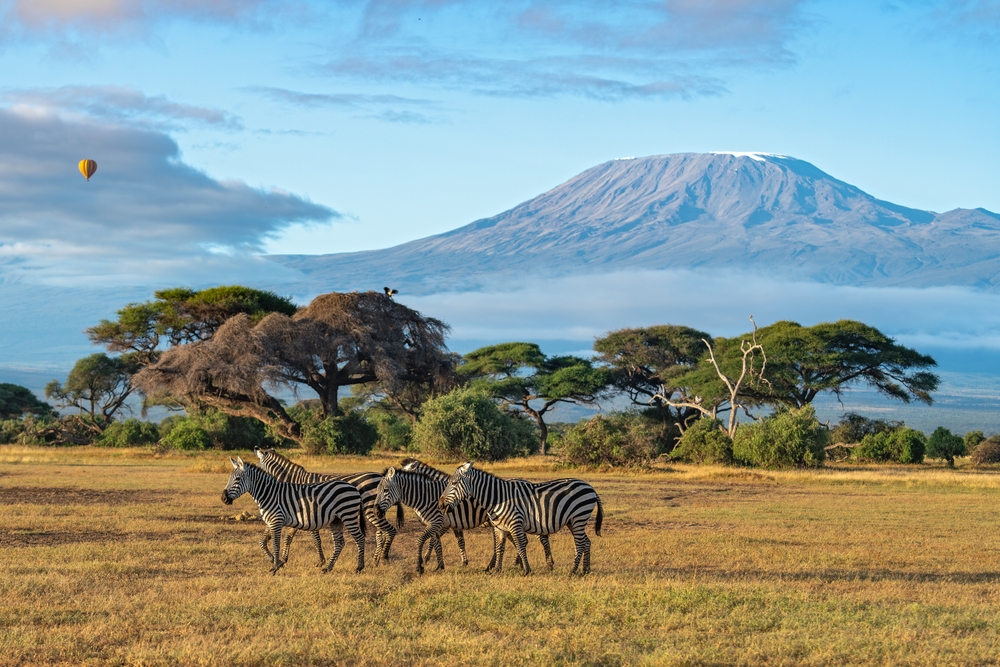
The first factor is the most obvious. Simply put, people climb mountains because they want to be there. They are drawn to the scenery, wilderness, and natural beauty of these environments.
In the study, this was one of the most highly valued motivations. Participants rated both “viewing the scenery” and “enjoying the wilderness” an average of 4.6 out of 5.
For nearly all of human history, our ancestors lived in close contact with nature. Today, many of us spend most of our lives indoors, surrounded by buildings, roads, screens, and other artificial environments. Perhaps we are drawn to wilderness because, until modern times, it was our home.
Mount Kilimanjaro is particularly appealing because of its extraordinary setting. Located in Tanzania, Africa, it is the highest free-standing mountain in the world and the tallest mountain on the continent. Climbers pass through several distinct ecological zones, from lush rainforest to alpine desert and the arctic conditions near the summit. Along the way, they encounter unusual vegetation, expansive views, ancient glaciers, and an enormous volcanic crater.
For many climbers, the opportunity to experience these landscapes firsthand is reason enough to make the journey.
So while Mallory said he climbed Everest “because it’s there,” for many of us, the answer for why we climb might be “because it’s pretty there.”
2. Challenge / Risk
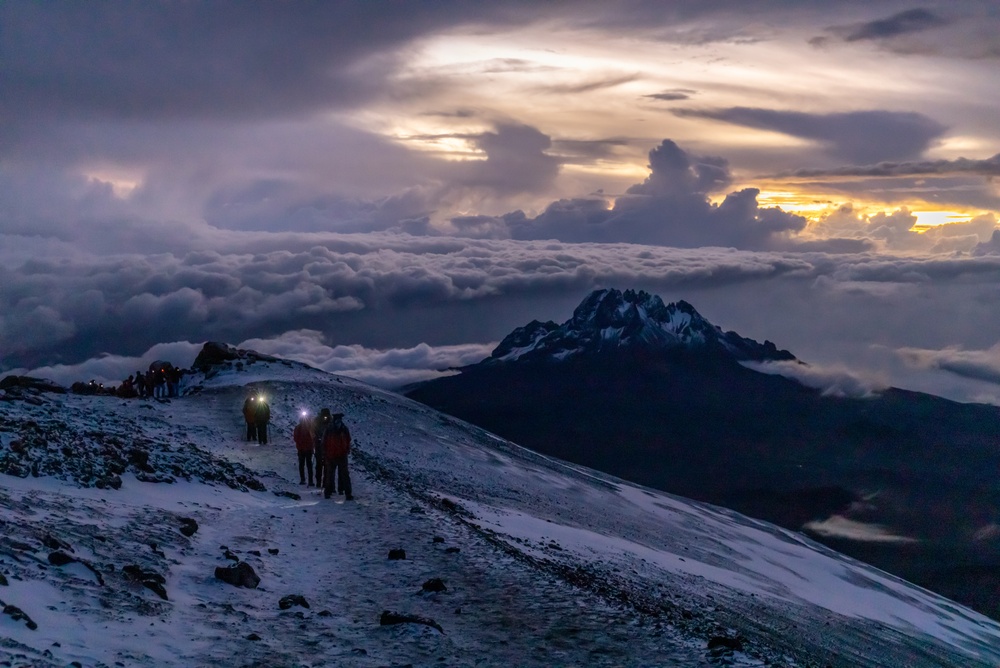
Challenge refers to the desire to test your abilities, overcome obstacles, and accomplish something difficult.
Risk refers to the possibility of failure, injury, death, or other negative consequences.
In mountaineering, challenge and risk often go hand in hand. Ewert’s research identified challenge and risk as related motivations, but that doesn’t mean every climber values them equally.
Kilimanjaro is often a starting point for people who want to challenge themselves in the mountains. Although it is a nontechnical climb suitable for beginners, reaching its summit requires physical endurance, mental determination, and the ability to cope with high altitude.
For some, the accomplishment inspires them to pursue increasingly difficult objectives. We’ve had clients who began their mountaineering journeys on Kilimanjaro and eventually went on to complete the Seven Summits, the highest peaks on each continent.
In Ewert’s study, the sense of accomplishment received an average rating of 4.4 out of 5. Risk-taking itself received just 2.8. This suggests that mountaineers are generally more motivated by the challenge than the danger itself. But for some, risk is part of the attraction.
3. Locus of Control
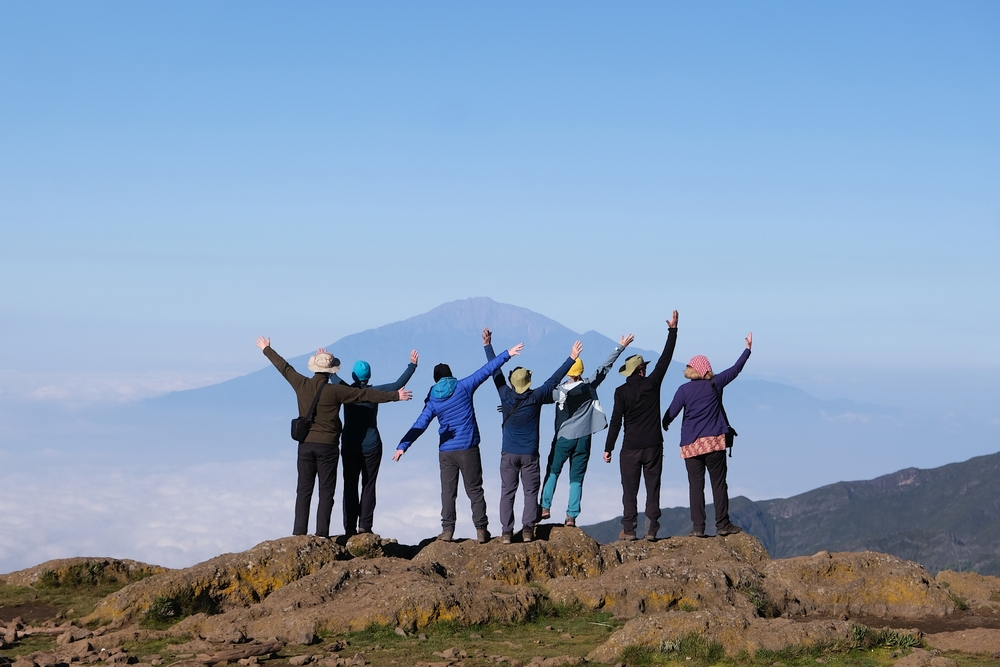
Locus of control is a psychological concept that describes how much control a person believes they have over the outcomes in their life.
People with an internal locus of control believe that outcomes are largely determined by their own actions.
People with an external locus of control believe that outcomes are largely determined by outside forces.
There’s a great line from the movie Titanic. As the ship is sinking, Billy Zane’s character says, “I make my own luck.” That captures the idea of an internal locus of control.
Ewert described this motivation as gaining personal control in a risky environment. There’s an interesting contradiction here. Mountaineers are attracted to having control over their outcomes, yet they deliberately enter environments that are uncontrollable and unpredictable. The forces of nature can present insurmountable obstacles where no amount of skill or preparation would make any difference.
However, on Kilimanjaro, weather rarely prevents climbers from reaching the summit. Preparation, pacing, and response to altitude play a much greater role. The outcome is never guaranteed. But what we do can make a tremendous difference.
4. Creativity / Problem Solving
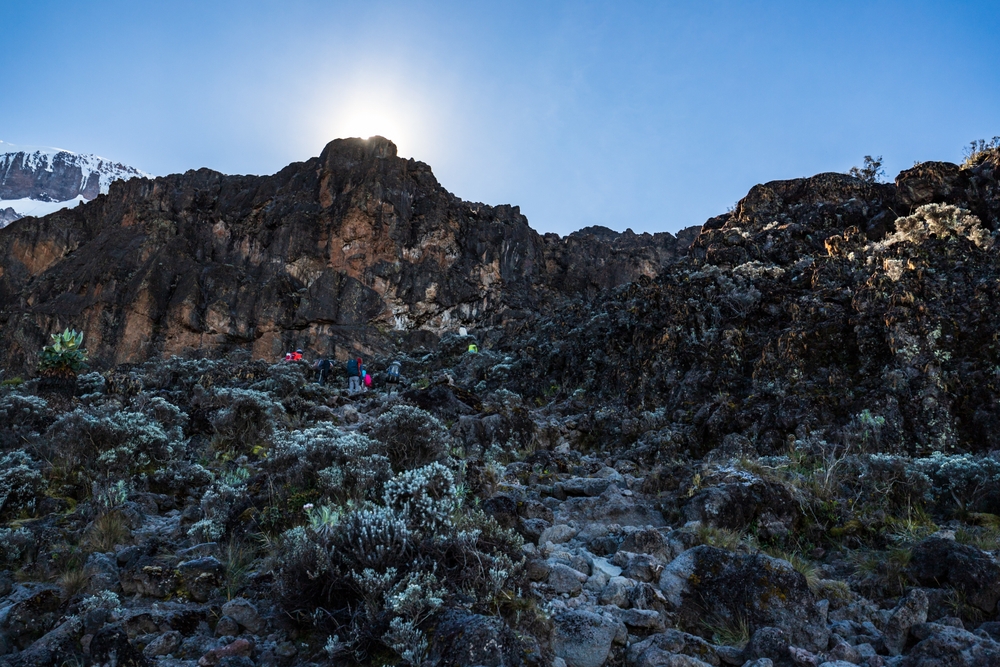
Mountaineering requires creative thinking and dynamic decision-making. From planning a route to adapting to changing conditions, it presents problems that are real, intricate, and constantly evolving. A plan that made sense last night may no longer be appropriate in the morning.
Ewert’s findings suggest that for some, the process of solving problems is rewarding, not merely a means of reaching the summit.
Mountaineering requires a combination of mental effort and physical demand. Not only do you need to act, but you have to think too.
On Kilimanjaro, much of the technical decision-making is handled by professional guides. However, climbers still face challenges that require ongoing judgment and adaptation. They must manage their energy, adjust to changing conditions, and respond to the physical and mental effects of altitude. As fatigue accumulates, even seemingly simple decisions can become more difficult.
Although the problems differ from those encountered in technical mountaineering, the ability to adapt and make sound decisions remains important.
5. Catharsis / Escape
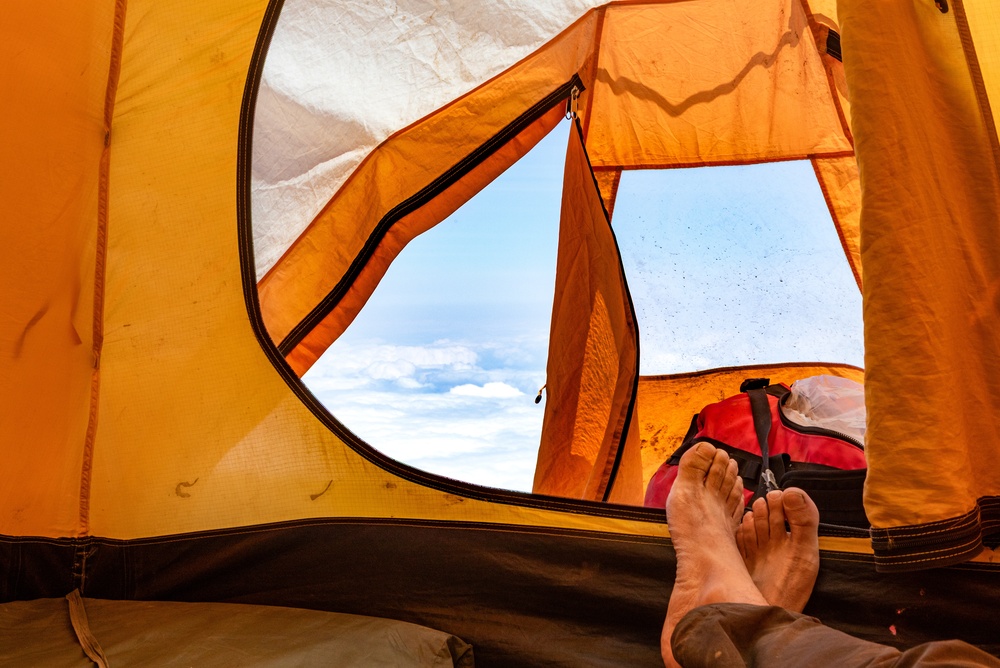
Catharsis refers to the release of emotional tension or stress.
Ewert identified escape as a motivation for mountaineering. For some climbers, getting away from their daily routines provides an opportunity to relieve stress and disconnect from everyday responsibilities.
But there’s something interesting about this. When most people want to get away from everyday stress, they look for relaxation. A tropical beach. A quiet cabin. Somewhere comfortable. Mountaineers do almost the opposite. They voluntarily enter environments that are physically taxing, uncomfortable, and sometimes dangerous. Yet somehow, the experience can be restorative.
Part of the explanation may be that climbing simplifies priorities. Attention is focused on the immediate task at hand. And as a result, the problems we left behind feel more distant and abstract.
A client of ours was initially hesitant about climbing Kilimanjaro because he was concerned about being away from his work responsibilities and children for nearly two weeks. He revealed he and his wife argued about this before he eventually agreed to go on the trip.
After the climb, he acknowledged how much he enjoyed his time on the mountain. He realized how badly he needed that break and was so grateful for the experience. He proved that sometimes we don’t appreciate how much we need to disconnect until we actually do.
6. Recognition / Image
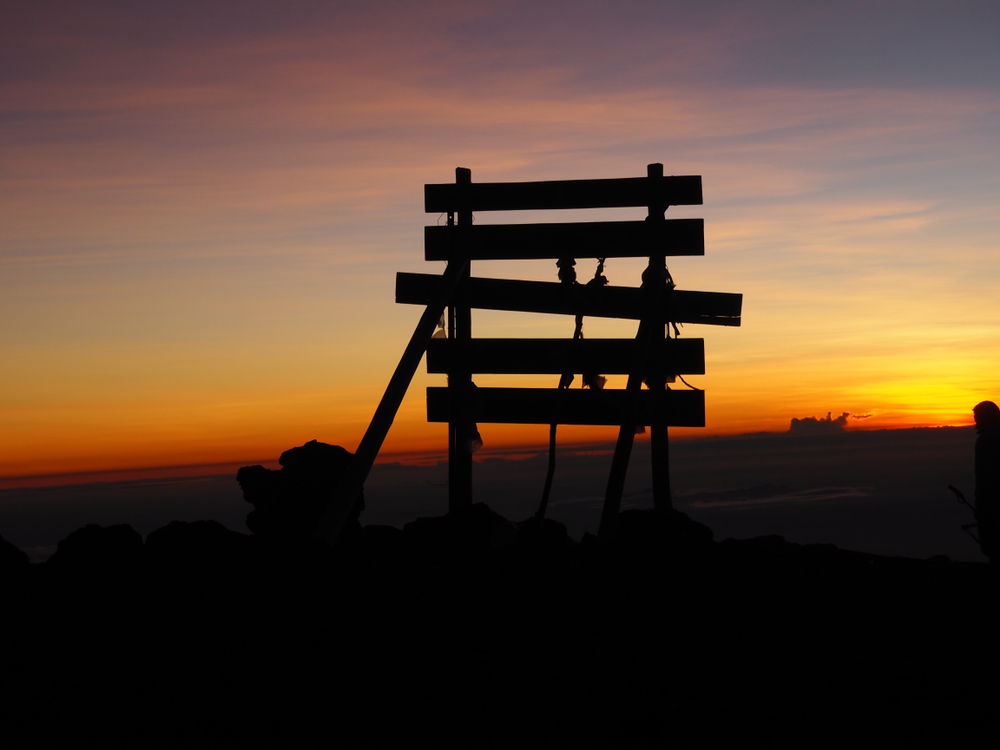
Recognition is about having your accomplishments acknowledged by others.
Image is about how other people perceive you.
It’s not difficult to see these motivations play out today. Summit photos and climbing videos are commonly shared across social media. I’ve noticed that many people use their Kilimanjaro summit photo as their main profile picture. It’s an accomplishment they’re proud of and one they’ve chosen to make part of their public identity.
But Ewert discovered something unexpected. Newer climbers placed greater emphasis on recognition and image. More experienced climbers increasingly valued challenge, personal testing, and locus of control.
One possible explanation is that climbing becomes less novel with experience, while one’s identity as a climber becomes more firmly established. When someone first starts climbing, reaching any summit can feel extraordinary. But after years in the sport, those experiences become more familiar. The accomplishment may still be meaningful, but the recognition that comes with it may become less important.
The experience hasn’t become less valuable. The evidence of the experience has.
Conclusion
Why do people climb mountains?
As Ewert’s research shows, there isn’t one universal answer.
People are drawn to mountaineering for different reasons, from the beauty of the natural environment to the challenge of accomplishing something difficult. Some seek opportunities to test their abilities, exercise personal control, or solve complex problems. Others value the chance to escape everyday responsibilities or gain recognition for their achievements.
These motivations aren’t mutually exclusive. A climber may be drawn to several factors, and their relative importance can change with experience.
Although Kilimanjaro is a nontechnical mountain, many of these same motivations can help explain its appeal. For some, it’s an opportunity to experience the landscapes of Africa. For others, it’s a significant physical and mental challenge, a chance to disconnect from daily life, or an accomplishment they’ve dreamed about for years. Whatever the motivation, climbing Kilimanjaro offers an opportunity to pursue something meaningful outside the routines of everyday life.
And understanding why you want to climb may help you appreciate the experience even more.