




Glacial Retreat on Mount Kilimanjaro

6a_kilimanjaro_461.jpg
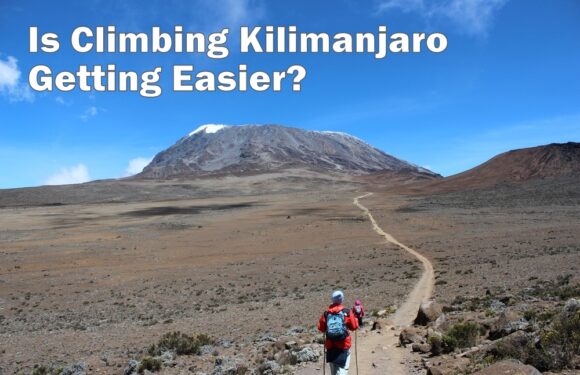
National Geographic News published some stunning satellite images of Africa last month, courtesy of United Nations Envitonment Program.  One of the images shows the glacial retreat occuring on Mount Kilimanjaro between 1976 and 2006.  It is estimated that the glaciers have decreased by 80% since the early 20th century.

This story follows after a May 1, 2007 National Geographic News article that stated that the earlier predictions of the glaciers disappearing by 2020 were “unrealistic.”  An Austrian-U.S. research team predicted that the ice atop Kilimanjaro would exist for another 30 to 40 years.

Additionally, the team attributes the glacial retreat to lower precipitation, and not global warming.

Continuing on the previous post on the Kilimanjaro Climb Survey, below are the summarized results of the last 10 questions:

  • 76% of climbers experienced at least one symptom of altitude sickness
  • 33% of climbers used Diamox
  • 100% of climbers rated their fitness level as “average”, “very good”, or “excellent”
  • 55% of climbers found summit day difficult or challenging
  • 37% of climbers found altitude acclimatization difficult or challenging
  • The most common rating for the climb difficulty was 7/10
  • 35% of climbers prepared for the climb primarily by hiking
  • Of those who trained, the median frequency was three times per week
  • Of those who trained, the median training time was two months
  • 18% of climbers did not train
  • 62% of climbers paid $1,500 or less for the climb
  • 92% of climbers rated their experience 8/10 or higher (10 = great)

The respondents’ susceptibility to altitude sickness is consistent with published figures citing that more than 75% of climbers will experience at least some form of mild AMS over 10,000 feet (Kilimanjaro is 19,340 feet high). While the most common symptoms among respondents are indicative of mild AMS, a few respondents showed symptoms of moderate or severe AMS. Most respondents chose not use Diamox.

All respondents rated their fitness level as average or better, which is good considering that 18% of respondents said they did not train at all for the climb. Of those who trained, the majority hiked, which is the best form of training, and trained three days per week, which is the minimum recommended frequency. Most operators recommend a minimum of two months of training; 66% of those who trained did so for more than two months.

The price respondents paid to climb Kilimanjaro is understated in today’s dollars due to the doubling of Kilimanjaro park fees over the past several years. The increase in these fees alone would increase the price per climber by around $300 (for a six-day climb). Therefore, it appears that adjusting for this increase would result in most respondents paying between $1,000 to $2,000 per climber if they were climbing today.

Finally, it is interesting to note that almost all climbers had a great experience on the mountain, regardless of all other measured variables - how old they were, when they climbed, what route they chose, how many days they climbed, and whether or not they reached the summit.

The detailed results of are shown below:

uksurvey2.jpg

Earlier this month, Ultimate Kilimanjaro posted a Kilimanjaro Climb Survey on the discussion forums of Lonely Planet, Summit Post and Trip Advisor.  The purpose of the survey was to collect data that could assist others who are considering climbing Kilimanjaro in their decision making. 

The survey was a short 20 question, multiple choice survey, and that took people an average of just over 3 minutes to complete.  As of today, there were 49 respondents.  Below are the summarized results of the first 10 questions:

  • male climbers outnumbered female climbers by 2 to 1
  • 54% of climbers were between 31 and 40 years of age
  • 22% of climbers obtained a medical check prior to climbing
  • 80% of climbers obtained all recommended vaccinations, immunizations and medications
  • 67% of climbers obtained travel insurance
  • July was the most popular month for climbing Kilimanjaro
  • 45% chose 6 day routes; 31% chose 7 day routes; 10% chose 9 day routes
  • 45% climbed Machame; 20% climbed Marangu; 16% climbed Lemosho  
  • Only 6% of climbers hiked to Kibo Crater
  • 84% of climbers reached Uhuru Point

The most surprising figure is that 84% of the respondents reached the summit, while it is widely cited that the overall summit success rate is about 50%.  However, there are a few possible explanations of the rather high success rate for survey respondents.  First, keep in mind that park statistics reflect that the Machame Route is slightly more popular than Marangu Route, but the respondents overwhelmingly chose Machame over Marangu (45% vs. 20%).  Also, only 10% did a 5 or less day climb.  The lack of respondents using Marangu and 5 or less day climbs would improve the survey’s summit success percentages tremendously. 

A good percentage of people who attempt Kilimanjaro have absolutely no hiking, backpacking or high altitude experience.  But the respondents on the cited forums are typically serious backpackers, independent travelers and mountaineers, all of whom have an advantage on Kilimanjaro versus their less experienced counterparts.  Finally, respondents are also likely to be people who succeeded on the mountain and had a good time doing it.

The detailed results of are shown below:

uksurvey.JPG

Can I Climb During the Rainy Season?

storm.JPGMost people avoid climbing during Mount Kilimanjaro’s two rainy seasons.  The long rainy season begins in mid-March and lasts through early June.  The short rainy season is from November to early December.  Bad weather makes climbing more difficult and less enjoyable in several ways.  Most obviously, rain makes you wet, which robs the body of warmth and heightens the risk of hypothermia.  Water causes changes to the terrain, making the ground muddy, soft and slippery.  Visibility is reduced by clouds, fog, wind and water.  So given this, why would anyone climb during the rainy season?

First, sometimes personal schedules do not allow someone to climb during the dry season.  And since the mountain is accessible year-round, they proceed with their trek.  Secondly, Kilimanjaro is a very popular (i.e., crowded) mountain during the dry season.  Those wanting to avoid the crowds choose the rainy season to have the park to themselves.  Lastly, although the chances of encountering precipitation during these time periods are significantly greater than Kilimanjaro’s dry season, it is not guaranteed that this is the case.  A large mountain like Kilimanjaro causes its own weather, which is notoriously unpredictable.  Therefore, the opportunity for great weather or foul weather exists no matter when a climb is attempted.

If one does plan on climbing during the rainy season, consider the following:  

  • The northern part of the mountain recevies less rain than the southern parts.  Therefore, Rongai is the preferred route when climbing during the rainy season.  Marangu is also good route because of the hut accommodations.
  • Quality rain gear is essential.  Climbers should make sure that they have waterproof, breathable jacket, pants and boots.  The day pack and duffel should be protected from rain with backpack covers or plastic bags.  Everything inside the pack and duffel should be stored in ziplock bags as well.  
  • The difficulty of a route increases with bad weather.  So do the dangers.  When climbing during the rainy season, it is better to plan less strenuous itineraries. 

Should I Climb the 6-Day Machame Route?

Attempting the Machame route in 6 days is very tough.  The standard 7-day route is shown here:

machame-itin.PNG

So to do the route in 6-days, you need to shave off one day from the standard route.  Here are the options:

  • On day two, trek from Machame to Barranco, without camping at Shira.  This is difficult because you’d have to climb from 2,850 m to 4,600 m and descend to sleep at 4,000 m.  You’ll be on the trail a long time, for 10-14 hours.
  • On day four, trek from Barranco to Barafu, without camping at Karanga.  This is difficult because it can take 8-10 hours to complete this leg, and then you can only sleep a few hours before you prepare for the midnight assault on the summit and descent, which can take another 11-14 hours.  Therefore, you’d be walking for 20 or so hours with only a few hours of sleep in between.
  • Through day five, you’d stick to the 7-day itinerary, trekking from Karanga to Barafu.  On day six, you’d summit and descend all the way to Mweka gate, instead of stopping at Mweka camp, and get off the mountain.  Summit day is already tough without adding an extra 3-4 hours to your walk.  This day may last 14-18 hours.

As you can see, none of these are ideal. Therefore the 6-day Machame route is not recommended. Unless you know you are a strong hiker and can adapt quickly to high altitude, the 7-day option is the best option.

How Should I Pack the Day Pack?

golitespeed1.jpgOn Kilimanjaro, most of your personal gear will be carried by hardworking porters.  As climbers begin their trek in the morning, the porters stay behind to break down the tents and clean the campsite.  Then, the porters proceed ahead of the climbers at a faster rate, beating the climbers to the next campsite to set up, prepare meals and boil water.  Therefore, climbers will often not see their porters again until they have reached their overnight destination and thus will not have access to the gear that the porters have transported until then. 

Climbers are expected to prepare their own day packs and to place all other items into a duffel bag for the porters.  As far as what goes into the day pack, it depends on what you may need during the day.  This typically includes rain gear, some extra layers of clothing in case the temperature drops, and clothing accessories.  Additionally, climbers should carry sunscreen, insect repellent (at lower altitudes), first aid kit, toilet paper, snacks and water.  The general rule is only carry what reasonably can be expected to be needed.  For instance, you do not need to carry fleece, insulated jackets, and gloves in the rainforest.  The sleeping bag and pad should not be carried, and probably would not fit, in your day pack.

To pack your day pack efficiently, you should use plastic bags to separate items based on categories.  For example, small bottles such as prescriptions, sunscreen, lip balm and hand sanitizer should be secured in a zip-lock type bag.  Extra layers of clothing should also be put into larger bags.  Paperwork, such as your passport and insurance documents into another bag.  Heavier items should be placed close to the midpoint of your back to keep your center of gravity in-line with your spine.  Placing heavy items near the top, bottom, left, right or rear of your day pack will cause you to lean forward, back, or to the side.  If your day pack has compression straps, tighten them so that your items do not move around as you walk.  Lastly, be consistent as to where you store your items (main compartment, side pockets, pant pockets, etc.), so that you do not fumble for your items when needed.  A medium sized backpack, with the capacity of  about 1,800 cubic inches (30 liters), is appropriate.

Do I Have to Wear Hiking Boots on Kilimanjaro?

80051330.jpgWhen choosing your footwear for Kilimanjaro, you should consider these factors:

  1. warmth
  2. waterproofness
  3. ankle support
  4. weight
  5. traction

For most people, the appropriate footwear is boots.  Compared to trail shoes, boots offer superior warmth, which will be immensely important should temperatures dip below zero.  Additionally, boots support the ankles that can help prevent the risk of injury.  Because of the height of the boots, your feet are less likely to get wet while stepping in puddles, snow or ice.  Lastly, the tread on a boot is also deeper, enabling a better grip on the terrain, whether it be mud, scree or rock. 

So given the above, why would anyone choose trail shoes?  The main reason is weight.  It is said that a pound on your feet is equivalent to carrying five on your back.  Therefore, an average pair of boots, which weighs more than three pounds is like adding fifteen pounds to your pack.  Walking with boots can be much more tiring when you think about how many steps you take on the climb.  But unless you are comfortable and used to hiking in trail shoes, in perhaps extremely cold weather, then Kilimanjaro is not the place to experiment. 

Do I Need a Yellow Fever Certificate to Enter Tanzania?

p5b.jpgBeginning on January 21, 2008, Kilimanjaro Airport reinstated health surveillance desks to enforce the Yellow Fever certificate requirement. All passengers entering from at risk areas must have been vaccinated. This includes passengers flying through Nairobi, even if they do not leave the airport. 

It appears that the Tanzanian government is phasing in the certificate requirement and being somewhat lenient for now. But eventually, the certificate will be required for all passengers entering Tanzania, whether or not they are arriving from an infected area.

Tanzania itself is an infected area, and Yellow Fever is no joke. So you should get the vaccination regardless. It needs to be in the body 10 days before it is 100% effective and is good for 10 years. This is a good brochure on Yellow Fever by the US Center for Disease Control.

Yellow Fever Information

Diamox: Does it Mask AMS?

brr07540.jpgThere is no evidence that Diamox (acetzolamide) masks AMS. It is approved by the FDA as a means of preventing and/or treating AMS. Therefore if you FEEL better while on Diamox, you ARE better.

To adapt to altitude, one needs to breathe more frequently during ascent to make up for the thinning air. What Diamox does is it increases the respiratory rate, speeding up acclimatization. The manufacturer of Diamox states that in their tests, “pulmonary function (e.g., minute ventilation, expired vital capacity, and peak flow) is greater in the acetazolamide treated group, both in subjects with AMS and asymptomatic subjects. The acetazolamide treated climbers also had less difficulty sleeping.”

What the manufacturer recommends it that it be used as a preventative measure, where you would take it 24-28 hours prior to rapid ascent, and throughout your climb (until descent). But some use it as a treatment, taking it only when symptoms of AMS arise.

Most people ignore this advice, but if one plans to possibly use Diamox on the climb, it is important that he/she should take a dosage for a day or two while in the comfort of their home to see what the effects are. There are some side effects (tingling hands, increased urination, hearing loss, taste loss, upset stomach, vomiting, confusion) to taking the drug, so one should be sure their body doesn’t have an adverse reaction before getting on the mountain with it. As you can see, some of those side effects can easily be confused with AMS.

Diamox is used for other purposes, like treating glaucoma, epilepsy and fluid retention. So who knows what else these chemicals may be doing to the body besides “increasing pulmonary function.” One should not take a drug without considering all the consequences, whether good or bad. And that’s why I neither recommend it nor do I discourage it… it’s up to the climber, based on their beliefs and hopefully based on information.

How Should I Dress for Kilimanjaro?

It is said that the trek from the gate to the peak of Kilimanjaro is like walking from the equator to Antarctica. The temperatures you may encounter on Mount Kilimanjaro can be over 100 degrees to well below zero. Therefore, it is important for all climbers to understand how to best dress to cope with the mountain weather. By following the provided gear list, you already have everything you need to stay comfortable and warm. 

Layering is a systematic, logical approach to wearing multiple layers of clothing. The advantages of layering are that it is versatile (a climber can add or remove layers to adapt to changing weather, activity level and body temperature), thermally efficient (multiple thinner layers are warmer than an equal thickness single layer), and space efficient (takes up less space in your backpack).You should follow the layering principle when you suit up for Kilimanjaro.

Technical clothing can be categorized into the following types of layers: base layer, mid layer, and outer shell.

Base Layer

1004.jpgA base layer is moisture-wicking item that is worn against the skin. By moving sweat away from your body, the base layer should keep you dry and provide some insulation. They are available in different thicknesses, although light-weight is recommended for its versatility over medium-, heavy-, and expedition-weight clothing. Base layers can be worn alone in warm weather, and can be doubled-up (worn on top of one another) during cold weather.Several types of fabric or blends of fabric are used to construct base layers, including silk, wool, and polypropylene, which are usually sold under registered trademarks by outdoor gear companies. Cotton is not a good base layer material! It does not have any moisture-wicking properties, does not dry quickly, and will actually increase your heat loss when wet.

2 - Long Sleeve Shirt, light-weight, moisture-wicking fabric
1 - Short Sleeve Shirt, light-weight, moisture-wicking fabric
1 - Long Underwear (moisture-wicking fabric recommended)
3 - Underwear, briefs (moisture-wicking fabric recommended)
1 - Bandana (optional)
1 - Balaclava
3 - Sock liners, tight, thin, synthetic, worn underneath to prevent blisters
1 - Gloves, light, thin, synthetic, worn underneath for added warmth (optional)
1 - Arm Warmers, synthetic (optional)

Mid Layer

The primary purpose of a mid layer is to provide warmth. Therefore, while searching for mid layers, you should look for those that have good insulating qualtities. Insulation is best created by materials that trap tiny air pockets, or dead air, between you and the elements.

Wool or synthetic fabrics can be used as a mid layer in cool weather. However, for cold conditions, use fleece, down or heavier synthetics. Fleece provides good insulation because it is relatively thin, fast-drying, comfortable, and light-weight, but lacks wind protection. Down is the most efficient insulating material, with respect to its warmth per ounce ratio, but loses its insulating qualities when wet. It is very compressible for packing, but bulky when worn. Therefore, select lightweight down products when used as a mid layer. Synthetic insulated jackets are not as warm or light as down, but they function even when wet.

1 - Soft Jacket, fleece or soft-shell
1 - Insulated Jacket, synthetic or down
1 - Fleece Pants
3 - Socks, thick, wool or synthetic
2 - Hiking Pants* (convertible to shorts recommended)
1 – Shorts* (optional)
*considered mid layers simply because they are worn on top of the base layer (underwear).

Outer Layer

or_chaos_jkt_was_07.jpg The outer layer is designed to provide protection from the wind, rain and snow. Some outer layers have built in insulation, but I recommend obtaining each layer separately for greater versatility.

1 - Waterproof Jacket, breathable with hood
1 - Waterproof Pants, breathable (side-zipper recommended)
1 - Knit Hat, for warmth
1 - Brimmed Hat, for sun protection
1 - Gaiters, waterproof (optional)
1 - Hiking Boots, waterproof, broken-in, with spare laces
1 - Gym shoes, to wear at camp
1 - Gloves (waterproof recommended)

With the above listed gear, you should be able to withstand whatever weather conditions Mount Kilimanjaro has in store for you. It is important that you be cognizant of changing conditions as you hike and adapt accordingly (unzip/shed layers before you sweat, zip up/add layers before you get cold, wear waterproof gear before you get wet, etc.)